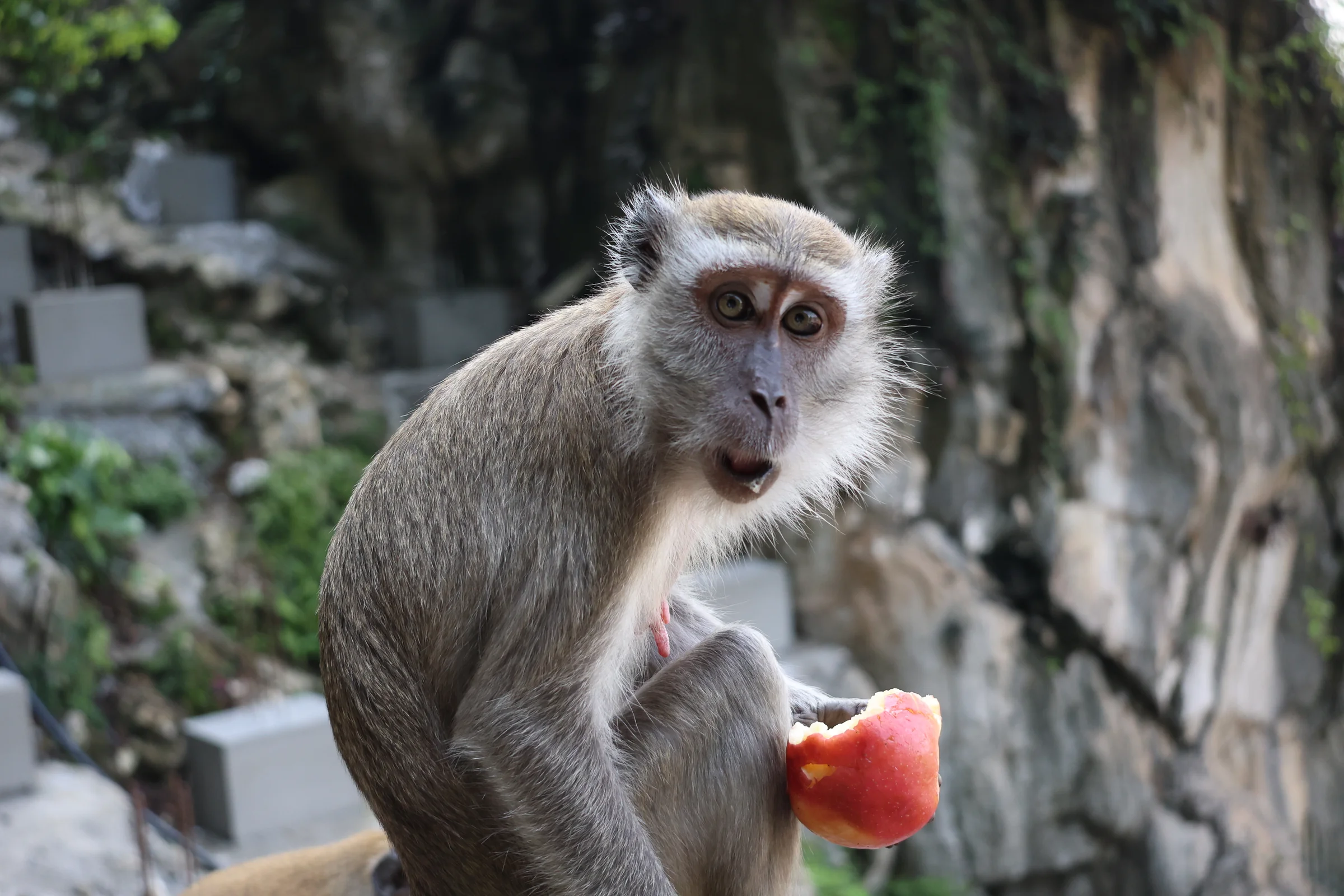
Lunch at Batu Caves
Batu Caves, Selangor, Malaysia26 September 2026
A long-tailed macaque (Macaca fascicularis), also known as a crab-eating macaque, sits holding a partially eaten red apple at Batu Caves in Selangor, Malaysia. The monkey has grey-brown fur, a pale face and prominent eyes directed towards the camera. Its slightly open mouth gives it an alert expression, while the surrounding limestone formations and vegetation provide a natural backdrop.
Long-tailed macaques are native to Southeast Asia and are among the region's most adaptable primates. They inhabit forests, coastal environments and increasingly urban areas, where they readily exploit food provided or discarded by humans. Despite their alternative name, crab-eating macaques are omnivores that consume fruits, seeds, insects and other available foods. They are highly social animals that live in structured groups, often called troops, containing multiple males and females. Social relationships are maintained through grooming, communication and dominance hierarchies.
At Batu Caves, one of Malaysia's most important Hindu temple complexes, long-tailed macaques have become a familiar sight along the temple approaches and surrounding limestone hills. The site is dedicated principally to Lord Murugan and attracts worshippers and tourists throughout the year, particularly during the annual Thaipusam festival. The monkeys have adapted to the constant presence of visitors and are known to approach people in search of food. Some snatch food, bags or other belongings, behaviour associated with their intelligence, opportunistic feeding habits and habituation to humans. A published study of Batu Caves macaques documented distinct social groups and behaviours including stealing, disturbing visitors and searching through rubbish.
The relationship between the macaques and human visitors illustrates wider challenges in wildlife management across Southeast Asia. Feeding by tourists and access to discarded food can encourage the animals to approach people more frequently, sometimes resulting in conflict. Although macaques living around tourist attractions can appear unusually comfortable near humans, they remain wild animals. Their presence at Batu Caves highlights the coexistence of wildlife, religious heritage and tourism within a rapidly urbanising landscape.
Usage and releases
An authorized download grants each public license marked Yes above, subject to its terms. Learn about usage.
Photo Details
Loading photo details…